Legal & Moral Commentary · Kenya 2026
In 1925, Gandhi distilled the moral failures of organized society into seven precise indictments. One hundred years later, each of them can be found in full expression in the corporate boardrooms, public offices, and political chambers of 2026 Kenya. This article does not merely describe them. It names them, locates them, and examines what the law demands in their place.
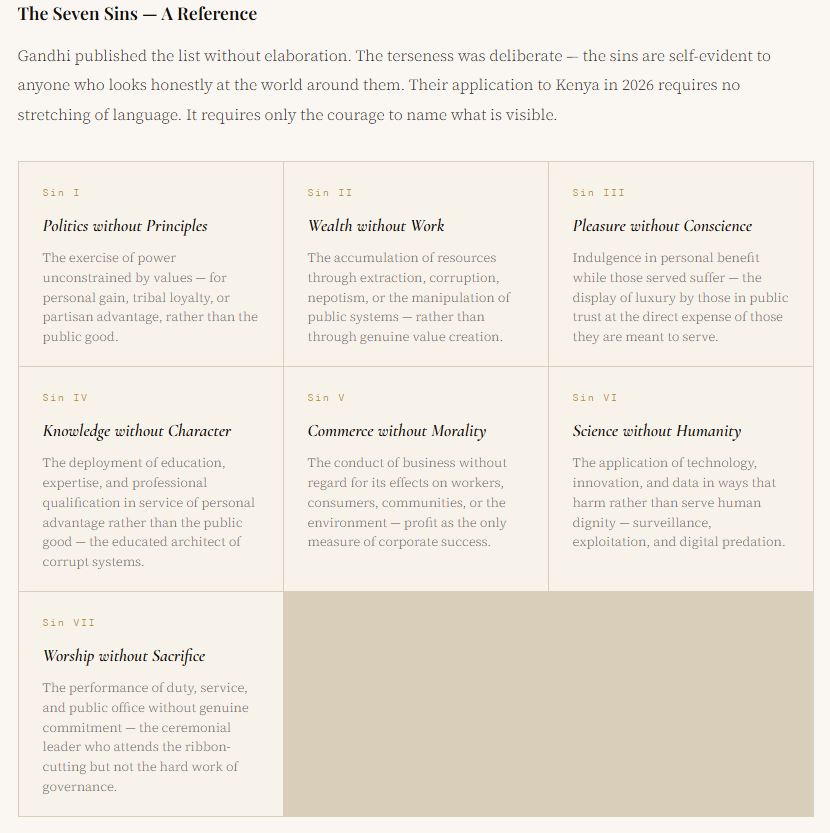
· Politics without Principles · Wealth without Work · Pleasure without Conscience · Knowledge without Character · Commerce without Morality · Science without Humanity ·Worship without Sacrifice
On 22 October 1925, Mahatma Gandhi published a short list in his weekly newspaper Young India. He called them the Seven Social Sins. He published them without commentary save for one line: “Naturally, the friend does not want the readers to know these things merely through the intellect but to know them through the heart so as to avoid them.” On the last day Gandhi spent with his grandson, Arun Gandhi, he pressed the same list into the young man’s hands on a slip of paper. It was his final lesson. It was also, a century later, an almost forensic description of the governance crisis that has brought a generation of Kenyan young people into the streets and that continues to corrode the institutions their parents and grandparents built.
The Anatomy of a Governance Crisis
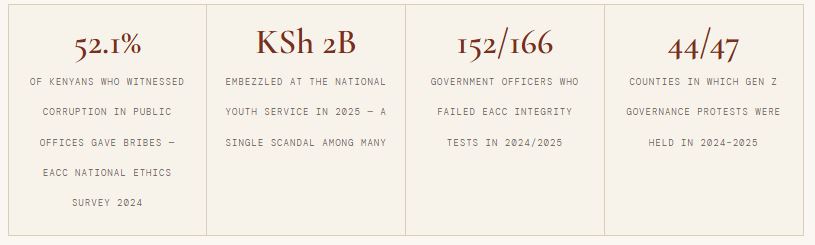
Between June 2024 and July 2025, young people organized protests across 44 of Kenya’s 47 counties including Nairobi, Mombasa, and Kisumu demanding an end to a Finance Bill they had not been consulted on, an end to corruption they had watched enriching a political class while they struggled for employment, and an end to a pattern of governance that had, in their lived experience, delivered nothing of the constitutional promise their country had made to them in 2010. 65 protesters were killed in summer 2024. The Finance Bill was withdrawn. The protests continued.
This was not a movement about tax. Over time, the demands evolved to decry the state of corruption, escalating public debt, accountability, impunity, incompetence, cronyism and wastage of public resources in both the executive and legislative arms of government. It was, in every meaningful sense, a generation holding up Gandhi’s seven sins and pointing one by one at the institutions of their country.
Good corporate governance is not a technical subject reserved for company secretaries and listed companies. It is the application of the same moral architecture that Gandhi described in organizational form. It is the structured, legally enforceable answer to each of the seven sins. This article examines the seven sins as Gandhi wrote them, as Kenya lives them in 2026, and as the law the Constitution, the Companies Act, the Leadership and Integrity Act, the Anti-Corruption statutes, and the full framework of Kenyan corporate and public law demands they be answered.
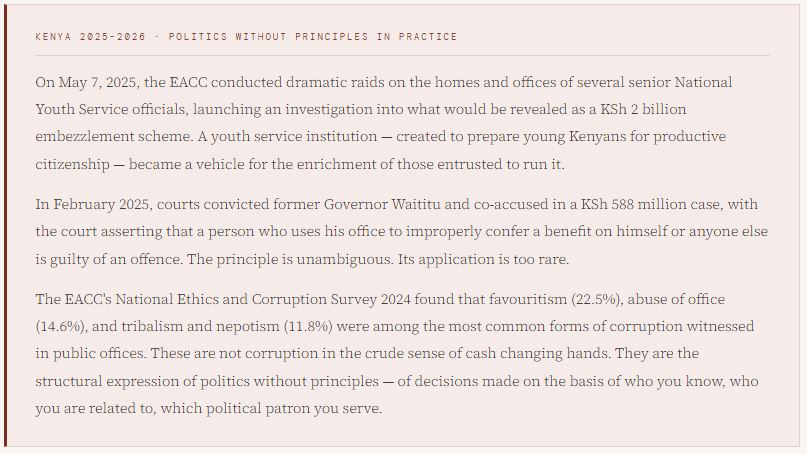
Gandhi’s first sin is the one that underlies all the others. When politics is conducted without principles when the exercise of public power is unmoored from values, unconstrained by accountability, and directed by personal interest rather than public service every other institution in society is affected. Laws are written to benefit the powerful. Contracts are awarded to the connected. Public resources flow to the loyal. The State becomes an instrument of extraction rather than a vehicle of service.

In Kenya in 2026, this sin is not abstract. Senior officials displayed opulence while ordinary Kenyans tightened their belts and struggled to put food on their tables, deepening public resentment. A Finance Bill proposed taxing bread, sanitary products, and mobile transfers while exempting helicopter spare parts a detail so brazen in its class character that it became the emblem of a generation’s disillusionment. Politics without principles does not always look like crude corruption. Sometimes it looks like policy written for the benefit of those who wrote it.
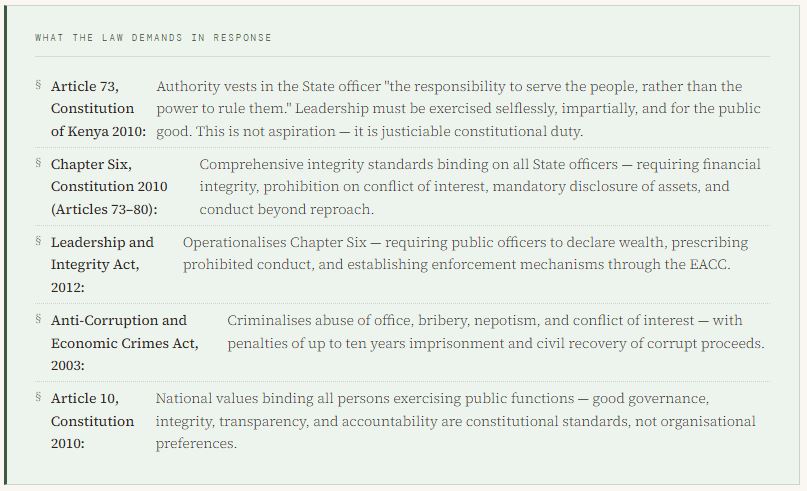
For corporate directors and company officers, the lesson of this sin is direct: the governance of a company is an exercise of delegated power over resources that belong, in a meaningful sense, to shareholders, employees, creditors, and the communities the company operates in. Exercising that power for personal benefit inflating expenses, awarding contracts to related parties without disclosure, approving transactions that enrich directors at shareholders’ expense is the corporate expression of politics without principles. The Companies Act 2015 and the CMA Code of Corporate Governance are Kenya’s legal answer to this sin in the private sphere.
Gandhi’s second sin is perhaps the most economically precise of the seven. He was not speaking about inheritance, or investment returns, or passive income. He was speaking about wealth that comes from the manipulation, extraction, or misappropriation of systems created for collective benefit wealth whose accumulation leaves the society poorer than it found it. A century later, in the language of corporate governance, this is called rent-seeking behaviour. In the language of criminal law, it is called corruption. In the language of the street, Kenyans in 2024 called it stealing from the hustler by the hustler.
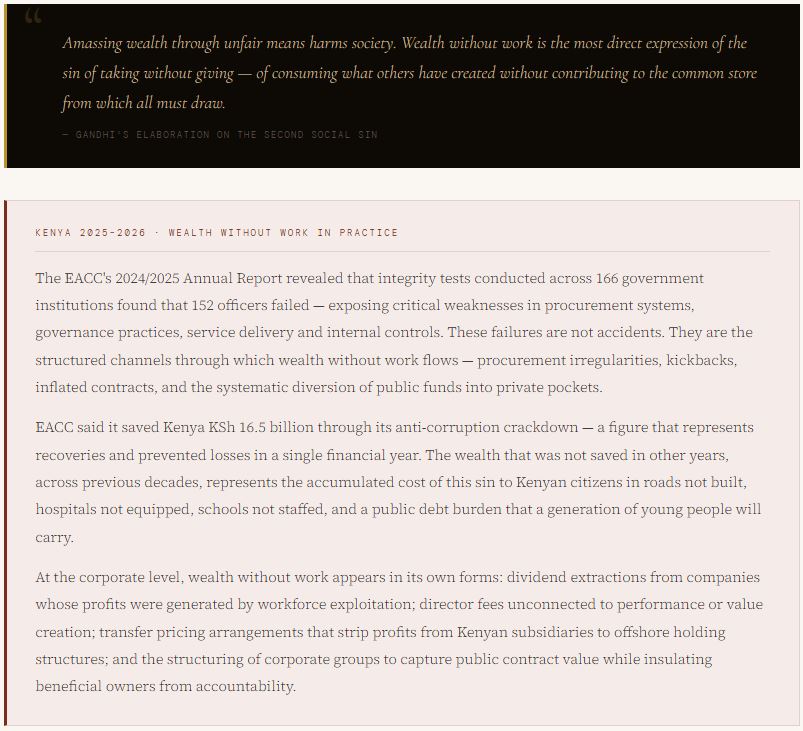
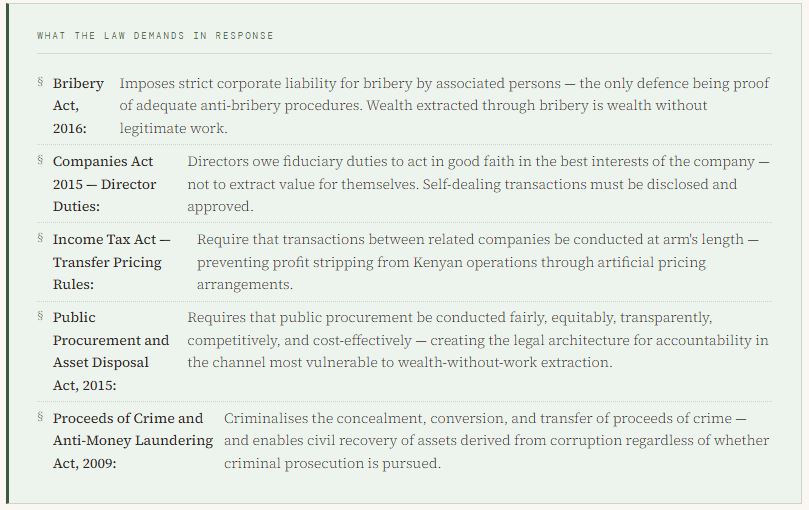
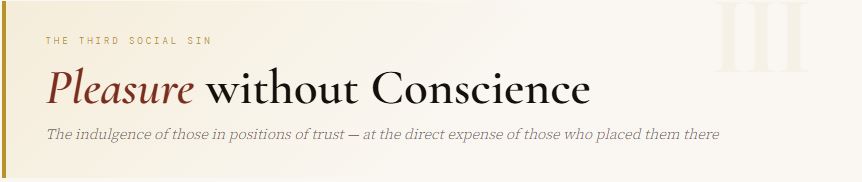
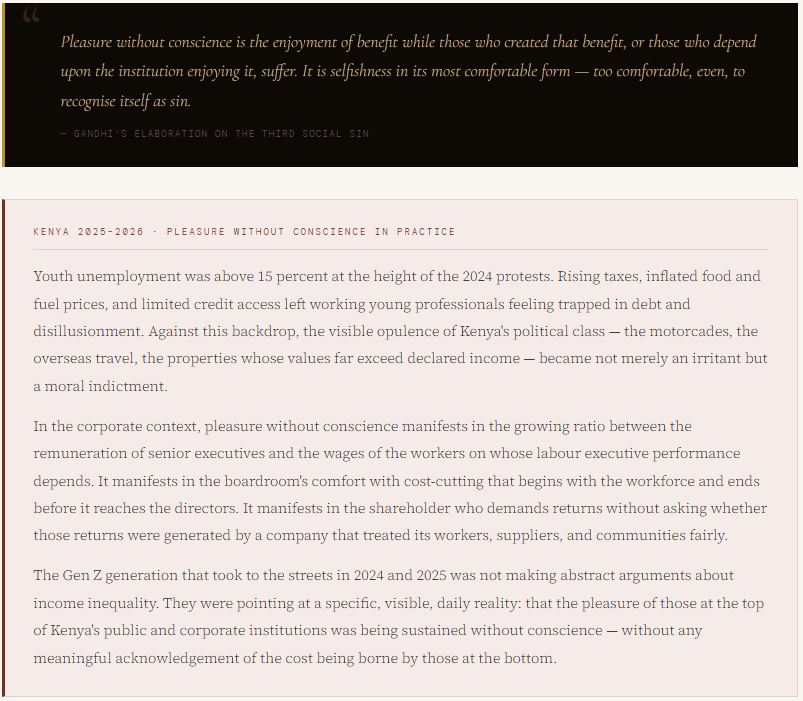
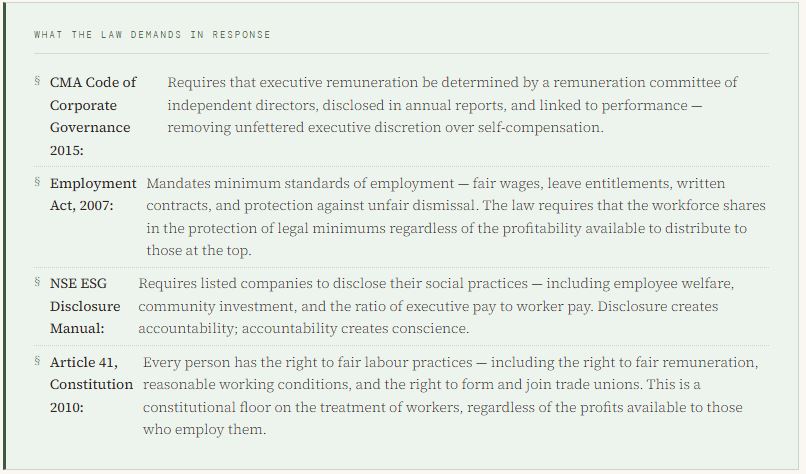
This sin is the most viscerally felt by those it harms. It is the sin of the public official who travels business class while the hospital they oversee has no medicines. It is the sin of the corporate executive who grants themselves a performance bonus in a year their company retrenched three hundred workers. It is the sin of the board that approves luxury perks for directors while refusing a minimum wage increase for cleaners. Gandhi was describing the moral anaesthesia that descends on those who have enough the selective blindness that allows comfort to coexist with the suffering of those dependent on the comfortable.

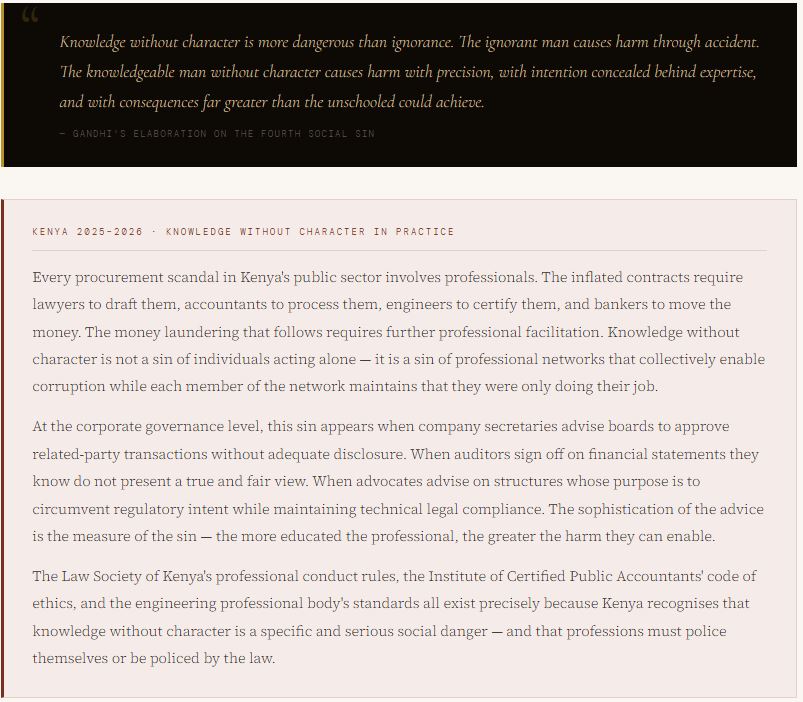
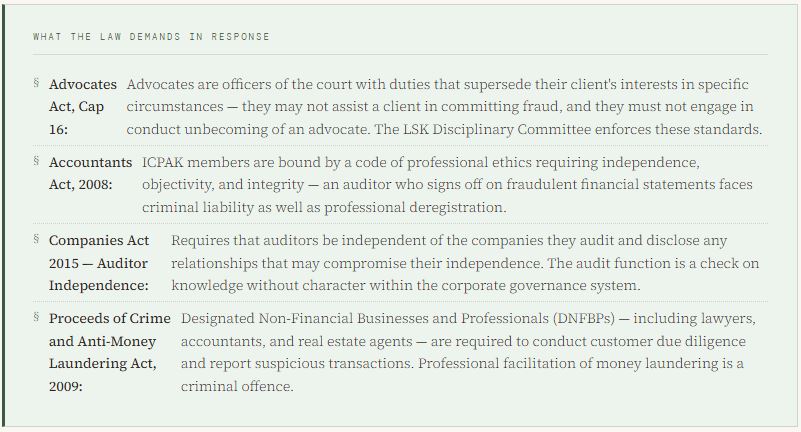
This is the sin that should concern every professional most acutely. Gandhi was not speaking about the ignorant or the uneducated. He was speaking about the lawyers who structure corrupt transactions with technical precision. The accountants who audit the books of companies they know are engaged in fraud. The engineers who approve substandard public works and collect their certification fees. The economists who design fiscal policies that they know will harm the poor while benefiting the connected. Knowledge without character is the weaponization of expertise the use of professional qualification in service of outcomes that the professional knows, or should know, cause harm.
“The most dangerous corruption is not the crude exchange of cash at a registry counter. It is the sophisticated structure, designed by educated professionals, that allows the extraction of public value while maintaining the appearance of legality. Character is what stands between expertise and its misuse.”

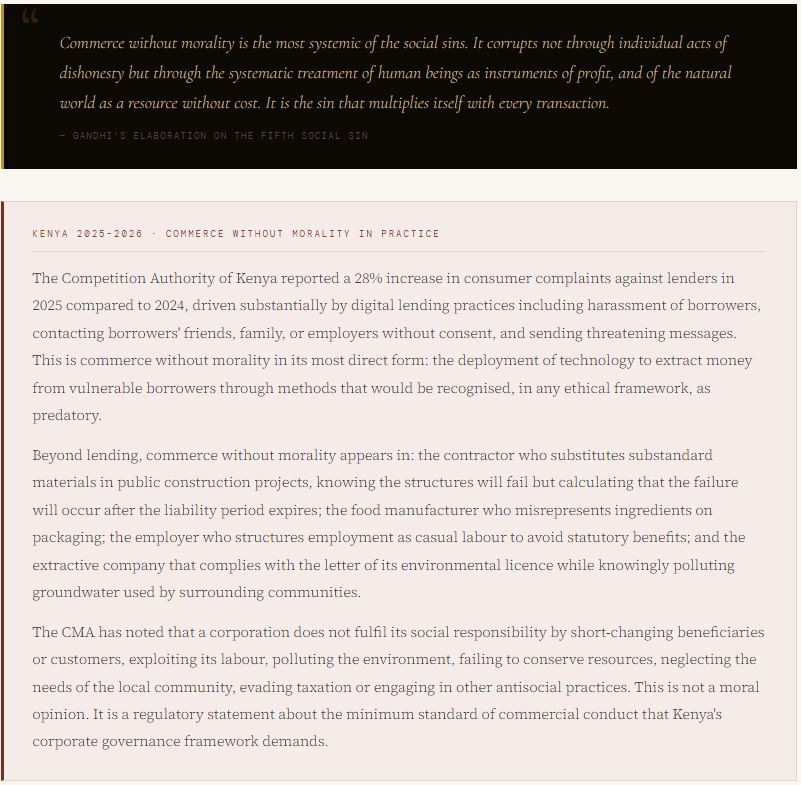
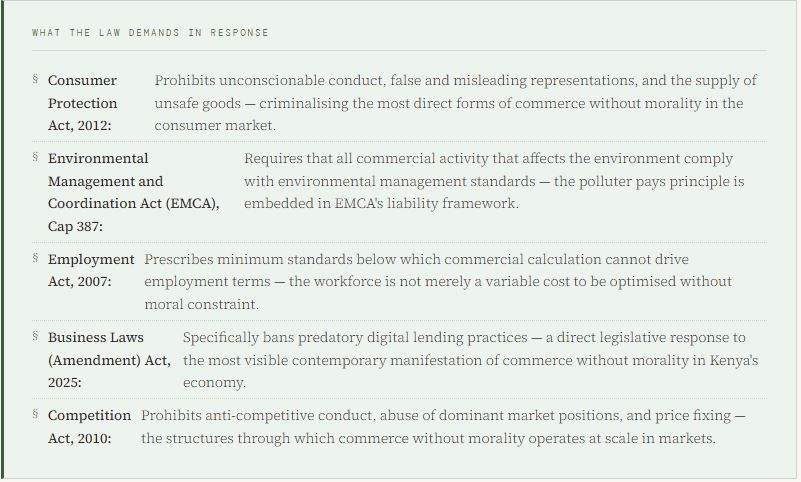
Gandhi was an economist as much as he was a moralist, and his fifth sin is directed squarely at the dominant tendency of unregulated capitalism: to treat commerce as a value-neutral activity whose only obligation is to generate returns for its owners. He understood, a century before ESG became a boardroom acronym, that business does not exist in a moral vacuum. It operates within communities, draws on labour shaped by families and schools funded by society, uses infrastructure built by governments and paid for by taxes, and creates environmental impacts that fall on people who never signed a contract with the company producing them.

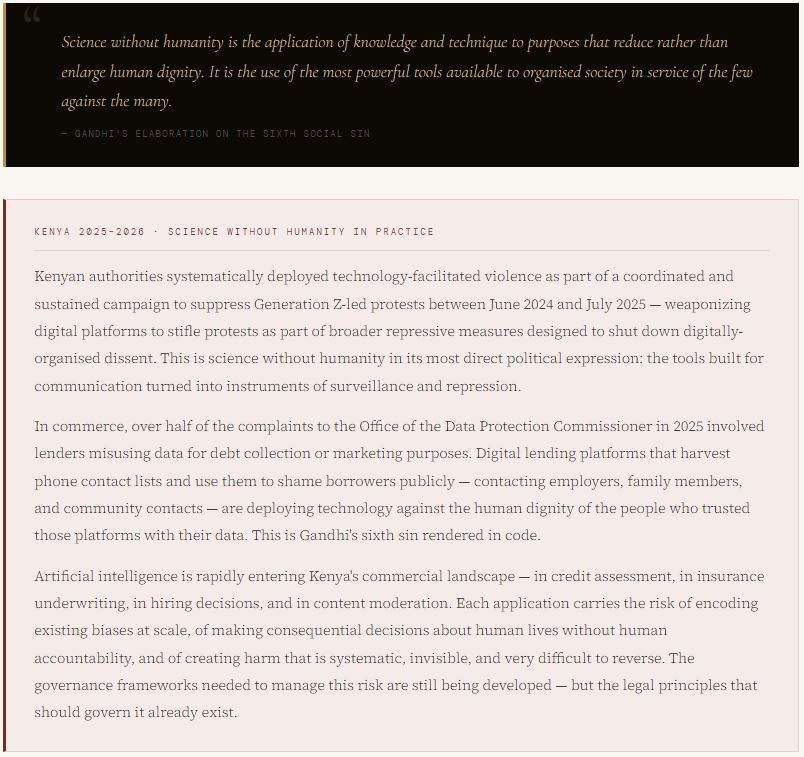
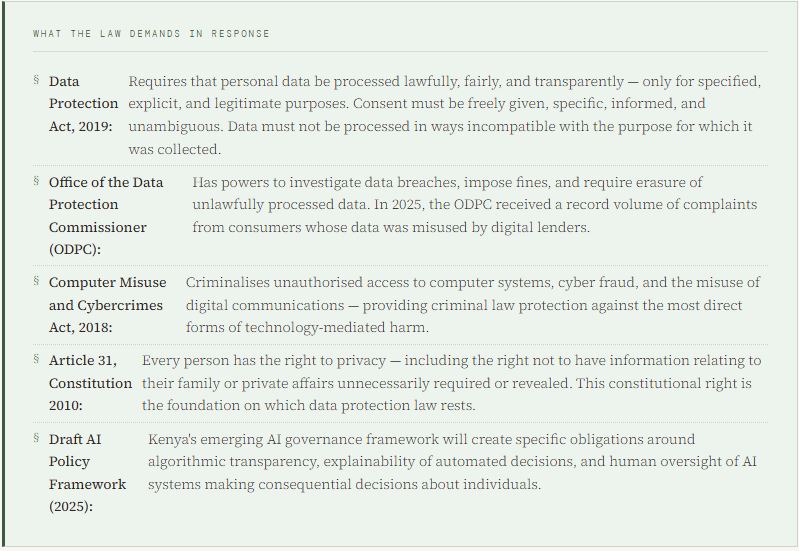
Gandhi wrote this sin in 1925, before computers, before the internet, before mobile money, before artificial intelligence. He was thinking about the industrialization of warfare, the use of science to build weapons of mass destruction, and the application of scientific methods to the organization of colonial exploitation. But as a principle, it is perhaps most urgently applicable to the world of 2026: the world of algorithmic credit scoring that denies loans to people in certain postal codes; of facial recognition deployed by security forces against protesters; of data harvested from millions of phone users and sold without their knowledge to advertisers and, in Kenya’s case, to political actors.
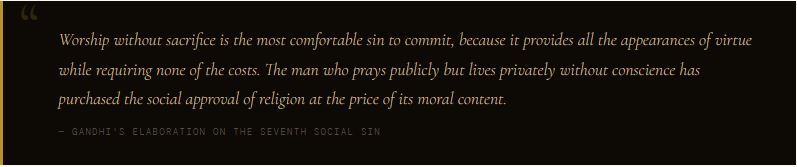
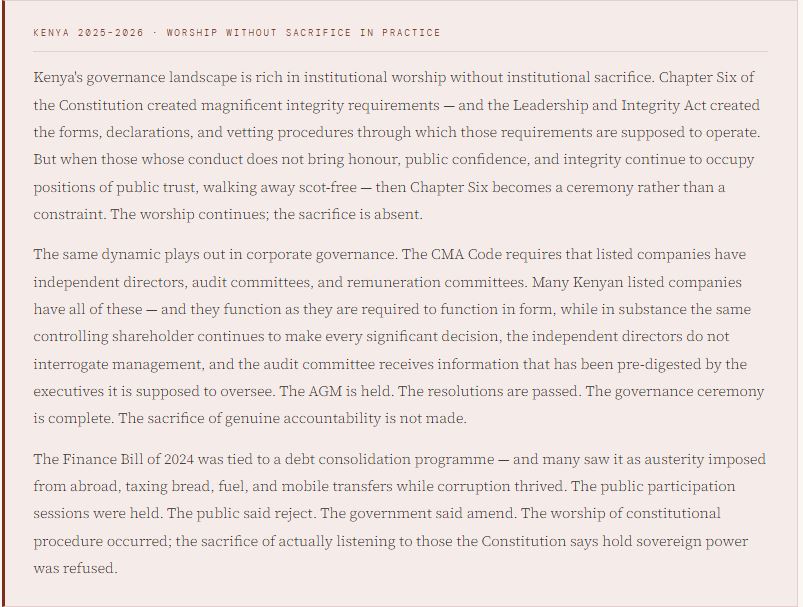
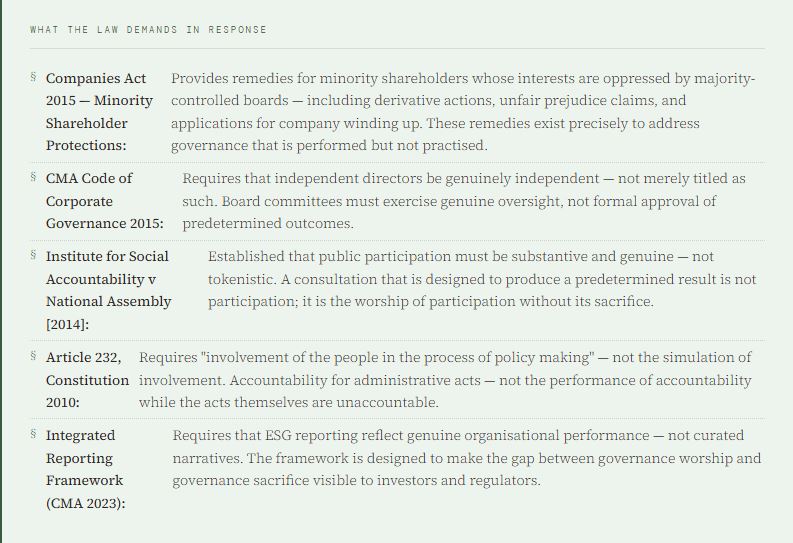
Gandhi’s seventh sin is the most subtle and, in many ways, the most dangerous because it is the one most easily mistaken for virtue. Worship without sacrifice is the performance of duty without its substance. It is the annual general meeting conducted not to hold management accountable but to ratify decisions already made. The corporate social responsibility report filed not to reflect genuine social investment but to satisfy a regulatory checkbox. The public participation exercise conducted not to hear the views of affected communities but to provide a procedural defense in future litigation. The board meeting at which the minutes are prepared before the discussion, and the resolutions are approved by the directors who wrote them. Compliance without commitment. Form without substance. Ritual without reality.
Good Corporate Governance as the Answer to All Seven Sins
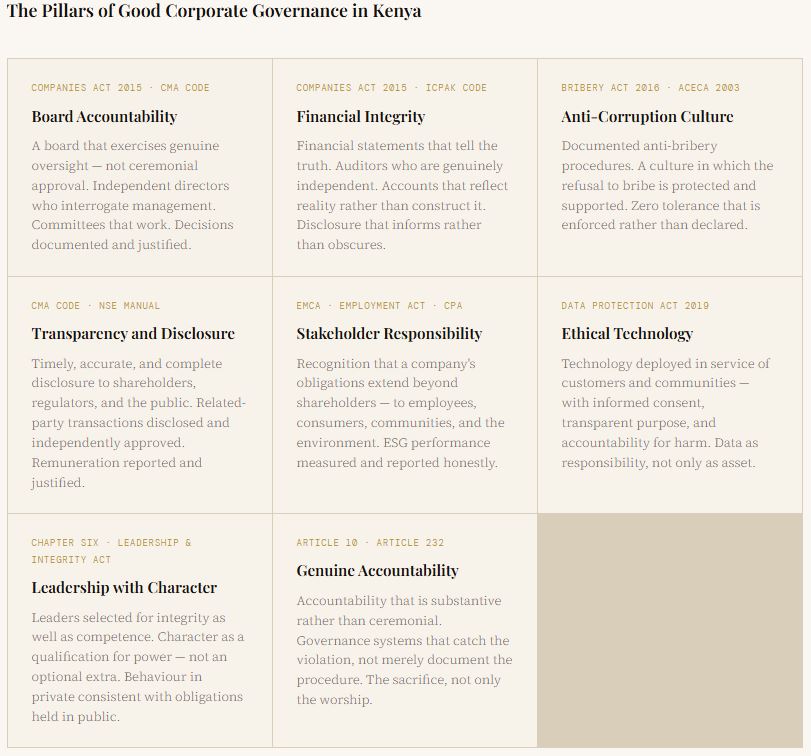
Gandhi’s seven sins are not seven separate problems requiring seven separate solutions. They are seven expressions of a single underlying failure: the failure to recognize that power whether political, corporate, professional, or technological is held in trust, not in ownership. Good corporate governance is the legal, institutional, and ethical framework that converts this insight into binding obligation.
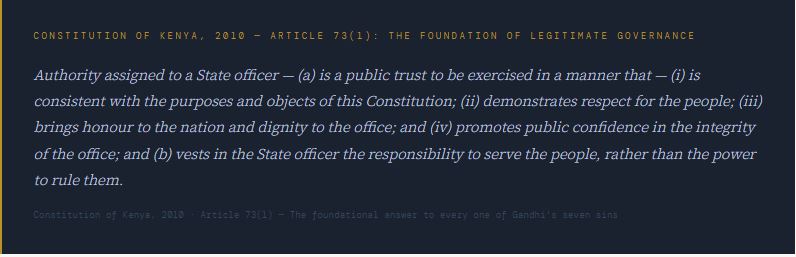
The Constitution of Kenya 2010 understands this. It transformed Kenya’s leadership paradigm, redefining it as a position of public trust rather than personal privilege. The Companies Act 2015 understands this directors are fiduciaries, not owners. The CMA Code understands this. The ESG framework understands this. Every layer of Kenya’s governance architecture, properly understood and faithfully applied, is an answer to one or more of Gandhi’s seven sins.
“Gandhi gave us the diagnosis in seven precise lines. Kenya’s Constitution, its statutes, and its courts have spent sixteen years building the cure. The question that remains the question the streets of 2024 and 2025 were asking is whether those who hold power have the character to take it.”
The Generation Z protests of 2024 and 2025 were not anti-constitutional. They were, in a profound sense, the most constitutional act of their generation a generation that read what Kenya promised them in 2010 and demanded to know why the promise was not being kept. They demanded accountability, the rule of law, jobs and access to quality education and healthcare for all. These are not radical demands. They are the minimum content of the constitutional and governance compact Kenya’s founding generation made with its successors.
Good corporate governance in the boardroom, in the public office, in the professional practice, and in the marketplace is the organized, legal, institutional answer to that demand. It is how a society moves from Gandhi’s diagnosis to the cure. It is, in the end, what the law requires and what conscience demands.
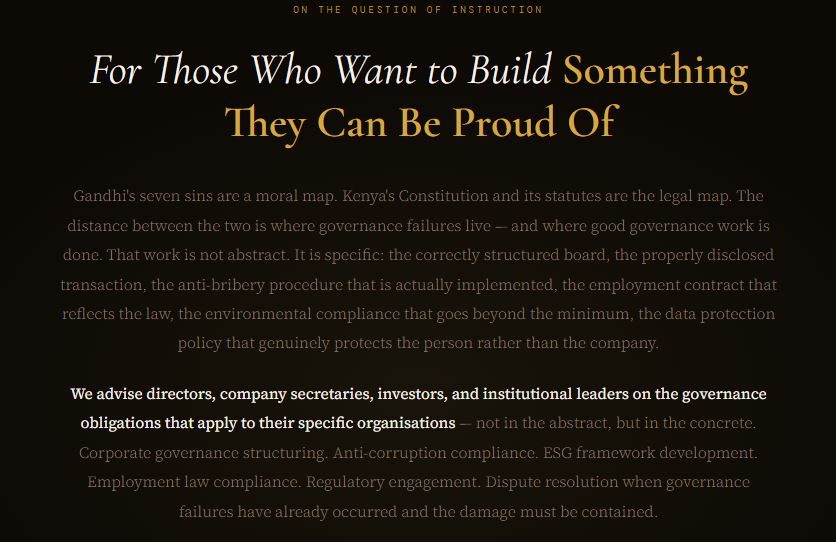
We have read Gandhi. We have read the Constitution. We read every statute we need to read to give advice that is both legally precise and ethically grounded because we believe, as advocates, that the practice of law is itself a test of knowledge with character. If you are building a business, restructuring a company, advising a board, or managing a regulatory challenge we are available for a confidential conversation about how to do it right.
O.M.O Law · Thika · Nakuru · Nairobi · Kenya · This article constitutes legal and moral commentary and does not constitute legal advice on any specific matter. For governance advisory services, please contact us directly.