Introduction — Understanding the Framework
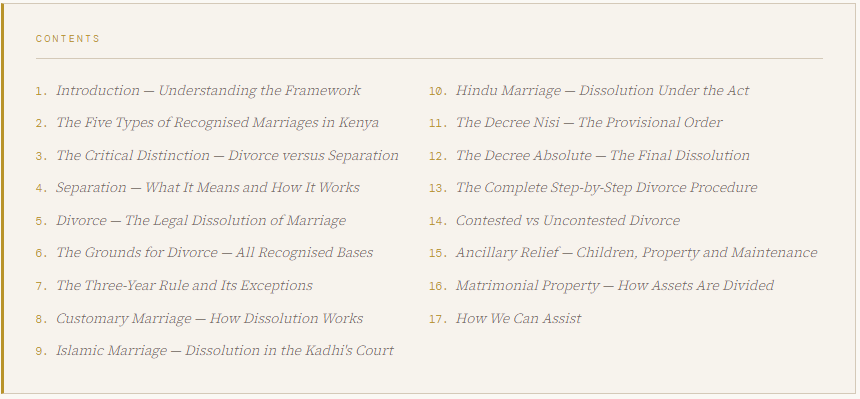
The dissolution of a marriage is one of the most consequential legal processes an individual will ever navigate and one that is too often entered without adequate understanding of the legal framework that governs it. In Kenya, the Marriage Act No. 4 of 2014 consolidated seven previously separate pieces of legislation into a single, comprehensive statute that recognizes five forms of marriage, establishes the grounds for their dissolution, and provides the procedural framework through which dissolution is obtained.
Understanding this framework before you need it or at the earliest possible stage after you recognize that you need it is the single most important step toward navigating the process with clarity, legal protection, and the minimum unnecessary cost to yourself, your family, and your financial position. This article provides that understanding, in full and with specificity, across every dimension of Kenyan divorce and separation law.
The Five Types of Recognised Marriages in Kenya
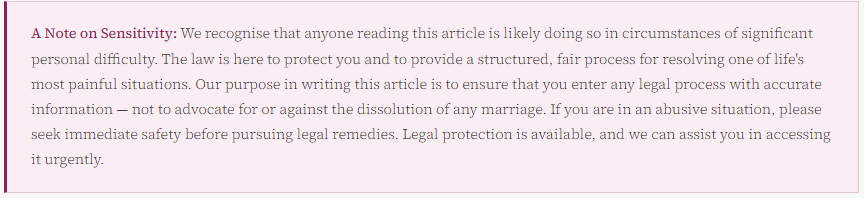
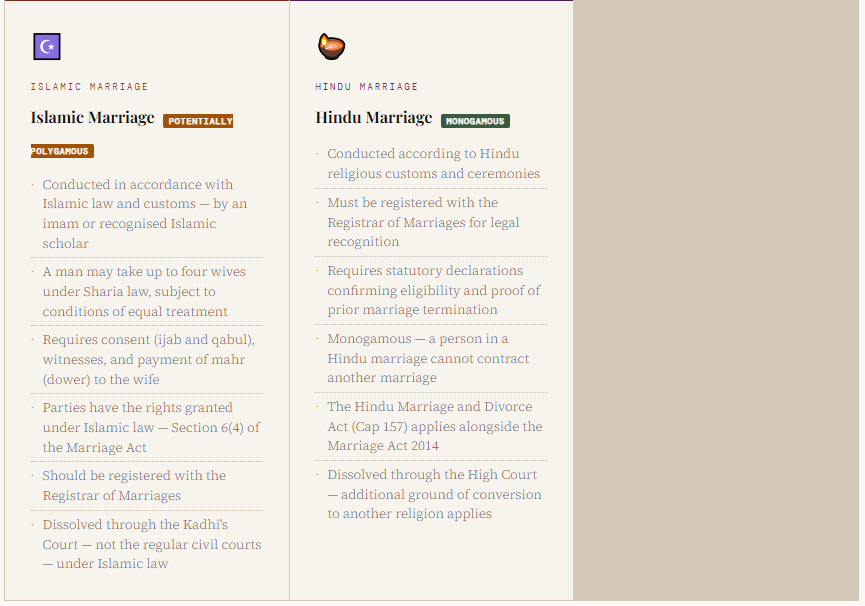
The Marriage Act 2014 recognizes five (5) systems of marriage each with its own requirements for formation, its own character as monogamous or potentially polygamous, and its own implications for dissolution. Understanding which type of marriage you are in is the essential starting point for any divorce or separation matter, because the applicable procedure, the available grounds, and the forum in which proceedings are conducted all depend on the nature of the
Marriage Act 2014 · Section 6 — The Universal Rule on All Registered Marriages
All registered marriages regardless of type have equal legal status under the Marriage Act 2014. Both parties to any registered marriage have equal rights and obligations throughout the marriage and at its dissolution. The minimum age for marriage is eighteen (18) years for all five types. Entering into marriage with anyone below this age is a criminal offence, and any such purported marriage is void.
Marriage Act No. 4 of 2014 · Section 6 · Article 45, Constitution of Kenya 2010
What About Cohabitation? — The Unregistered Union
Cohabitations where a man and a woman live together as husband and wife without formal registration of any marriage are not legally recognized as marriages by the Marriage Act 2014. A court of law may, in some circumstances, consider specific aspects of a long-term cohabitation relationship particularly where the couple publicly held themselves out as married but this is not guaranteed and is not a substitute for a legally registered marriage. Parties in unregistered cohabiting relationships have significantly fewer legal protections at the end of the relationship, particularly in relation to property division, inheritance rights, and succession. If you are in a long-term cohabiting relationship, we encourage you to seek legal advice about how to protect your interests.
The Critical Distinction — Divorce versus Separation
The distinction between divorce and separation is not merely semantic. It is a fundamental legal difference that determines whether you remain legally married, what rights and obligations continue to exist between you and your spouse, whether either of you can remarry, and what financial and property consequences flow from the end of the day-to-day relationship. Understanding this distinction is the foundation of every decision that follows.
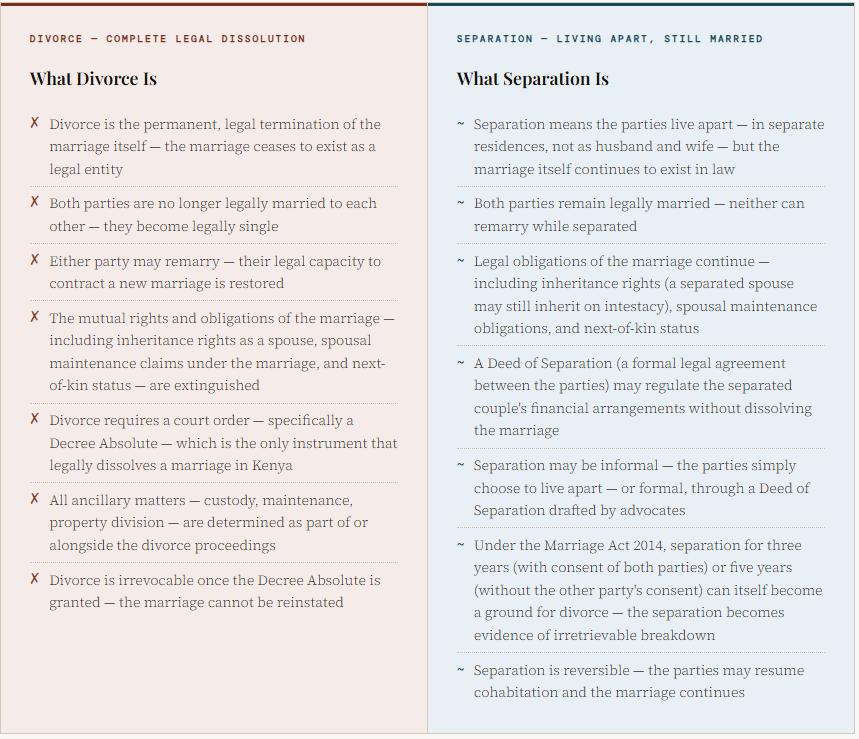
“Separation is the pause button. Divorce is the stop. A separated couple is still a married couple with all the legal rights, obligations, and consequences that marriage carries. The law does not automatically convert separation into divorce, however long the separation endures. Only a court can dissolve a marriage.”
In practical terms, many couples in Kenya choose separation as a first step either because they are uncertain whether divorce is the right decision, because they have religious or cultural reasons to avoid formal divorce, or because they want to create a legally structured framework for their financial arrangements and child custody without immediately dissolving the marriage. There is nothing unlawful about separation, and a Deed of Separation can provide significant practical protection to both parties during the period of living apart.
Separation — What It Means in Practice and How to Protect Yourself
When a marriage breaks down to the point where the parties no longer wish to live together, but neither party is yet ready to or able to proceed with formal divorce, separation is the interim legal framework that can provide structure, protection, and clarity. There are two main forms separation takes in practice in Kenya.
Informal Separation
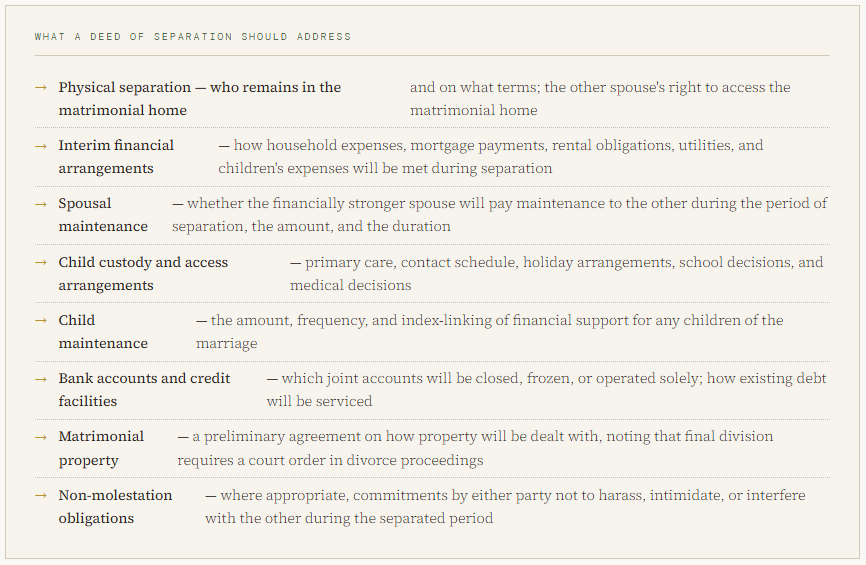
Informal separation is simply the physical act of living apart one spouse leaves the matrimonial home and the parties cease to live together as husband and wife. There is no court process, no legal document, and no formal legal status created. The marriage continues to exist in law. The risk of informal separation is that without any documented agreement, disputes about property, money, children, and maintenance are likely to arise with no pre-agreed framework for resolving them. A separated spouse who allows their partner to manage or dissipate matrimonial property during a long informal separation may find their financial position significantly worsened by the time formal divorce proceedings begin.
Formal Separation — The Deed of Separation
A Deed of Separation is a formal, legally binding agreement between the parties, drafted by their advocates, that records the terms on which the parties agree to live separately. It does not dissolve the marriage both parties remain legally married but it provides a contractual framework that governs the separated period and, where the separation eventually leads to divorce, provides a documented record of the parties’ intentions and arrangements.
Separation as a Ground for Divorce
The period of separation if it is sufficiently long becomes relevant to divorce proceedings. Under the Marriage Act 2014 and the principle of irretrievable breakdown, a separation of at least two years can form the basis of a divorce petition as evidence of irretrievable breakdown. Specifically: separation for three years or more with the consent of both parties, or five years or more without the other party’s consent, constitutes a ground for divorce. The dating of the commencement of separation is therefore legally significant it should be documented, ideally through the Deed of Separation, as the agreed date from which the parties began living apart.
Divorce — The Legal Dissolution of Marriage in Kenya
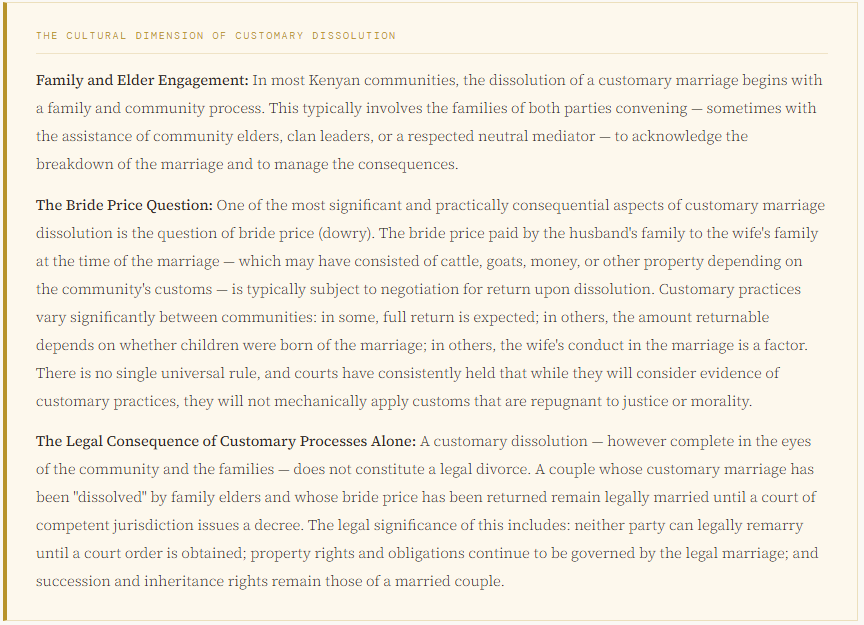
Divorce in Kenya is the formal, permanent, court-ordered dissolution of a marriage. No marriage in Kenya can be dissolved except by order of a court of competent jurisdiction Section 66 of the Marriage Act 2014 establishes this principle explicitly. A customary ceremony, a religious declaration, a family elder’s pronouncement, or a separation agreement however sincere and however publicly acknowledged does not constitute a legal divorce. Only a court order does.
The primary statute governing divorce is Part X of the Marriage Act No. 4 of 2014, supported by the Matrimonial Causes Act and the Matrimonial Property Act 2013. Together, these statutes establish: the sole ground for divorce (irretrievable breakdown); the circumstances that constitute irretrievable breakdown; the court in which proceedings must be filed; the procedural requirements; and the ancillary matters children, maintenance, property that must be determined alongside or following the dissolution.
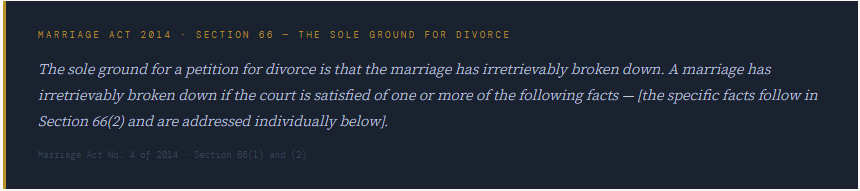
The language of Section 66 is significant: there is one ground irretrievable breakdown but that ground is established by proving one or more of several specific facts. The practical effect is that Kenya operates a fault-based system in which you must demonstrate to the court’s satisfaction that the marriage has broken down through one or more of the enumerated circumstances. A court will not grant a divorce merely because the parties are unhappy together, have grown apart, or have incompatible personalities unless that incompatibility is established through one of the specific statutory grounds.
The Grounds for Divorce — All Recognised Bases in Full
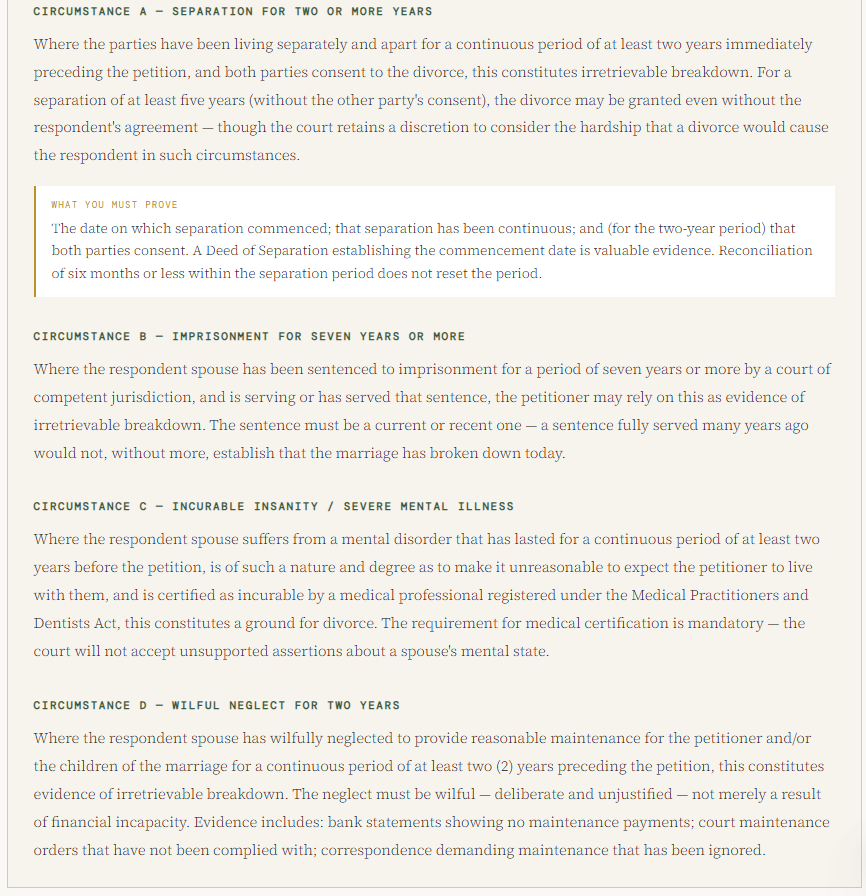
The following are the specific facts whose proof establishes irretrievable breakdown for the purposes of a divorce petition in Kenya. Each ground has its own evidentiary requirements, and understanding what must be proved and how is essential before filing.
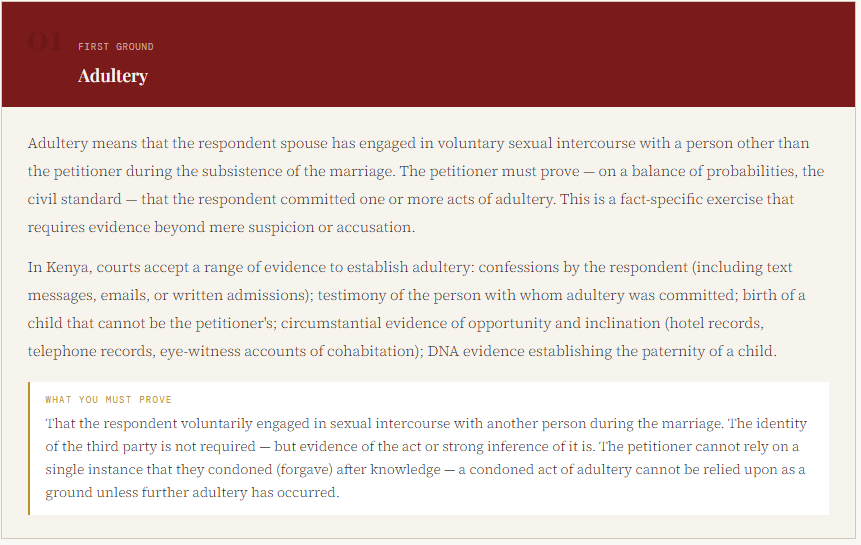
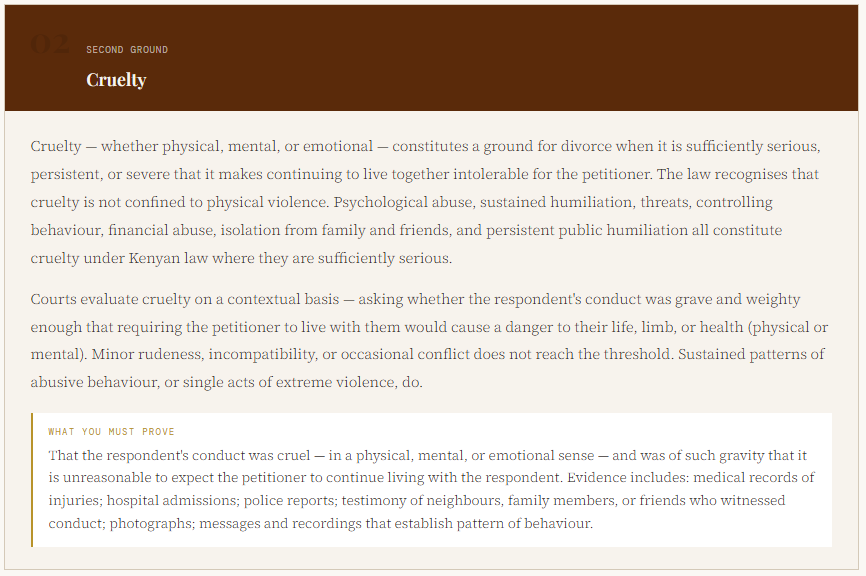
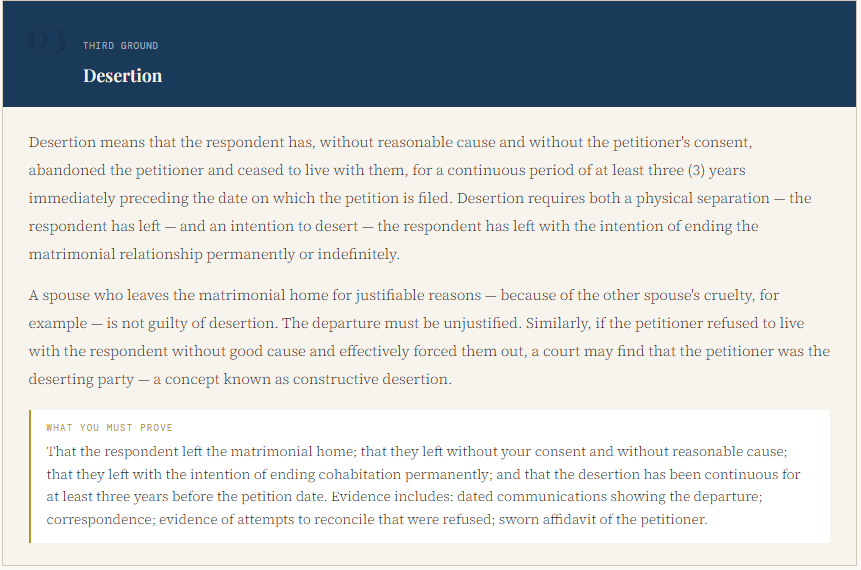
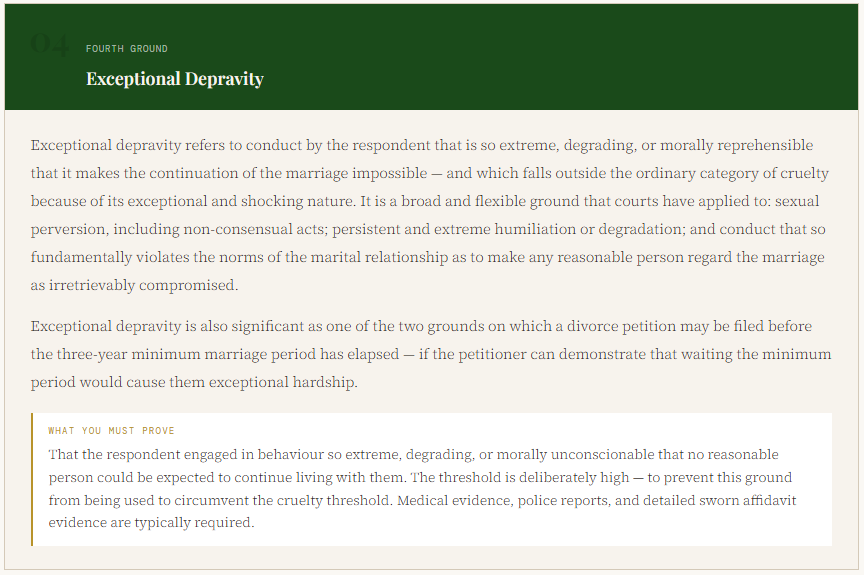

Beyond the four fault-based grounds above, the Marriage Act 2014 recognizes several additional circumstances that establish irretrievable breakdown circumstances that do not necessarily require proof of any moral fault by either party, but which demonstrate that the marriage has failed in a fundamental and unrecoverable way.
The Three-Year Rule — The Minimum Marriage Period and Its Exceptions
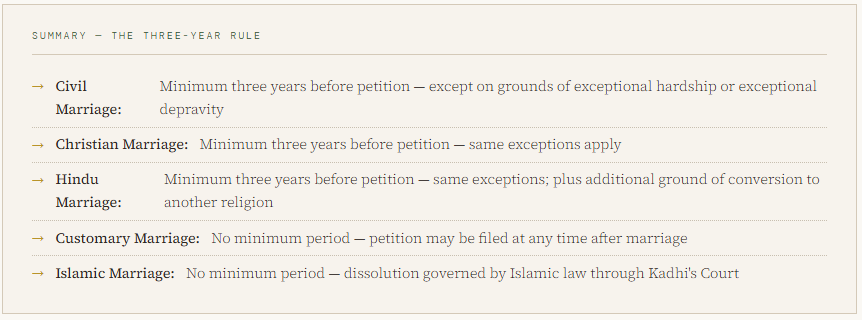
For civil and Christian marriages, the Marriage Act 2014 provides that the court shall not ordinarily hear a petition for divorce unless the parties have been married for at least three (3) years. This rule reflects the public policy position that marriages deserve a reasonable opportunity to succeed before the courts will dissolve them, and that the courts should not be used as an instant exit from a relationship that has encountered early difficulties.
The three-year restriction does not apply to all marriages. Customary marriages may be dissolved at any time there is no minimum period requirement. Islamic marriages are governed by Islamic law through the Kadhi’s Court and do not carry the same three-year minimum. For Hindu marriages, the three-year rule applies with the same exceptions.
Exceptions to the Three-Year Rule
A petitioner may apply to the court for leave to present a petition before the expiry of three years where it would cause exceptional hardship to the petitioner to wait, or where the case is one of exceptional depravity on the part of the respondent. In assessing whether to grant leave, the court will consider: the interests of any children of the marriage; whether granting leave would prejudice the chances of reconciliation; and the severity of the hardship or depravity alleged.
Customary Marriage Dissolution — When Tradition and Law Intersect
The dissolution of a customary marriage is a two-dimensional process it has both a cultural/community dimension and a legal/court dimension. Understanding both is essential, because fulfilling only one without the other leaves the dissolution incomplete in either the cultural or the legal sphere, with potentially significant consequences.
The Grounds for Customary Marriage Dissolution
A customary marriage may be dissolved on any of the general grounds under the Marriage Act 2014 adultery, cruelty, desertion, exceptional depravity, and irretrievable breakdown applicable to all marriages. Additionally, the court may take into account any valid ground recognized under the specific customary law of the parties involved, where that ground is proven by evidence of the customary practices of the relevant ethnic community. Courts have accepted evidence of: chronic failure to fulfil bride price obligations as a ground; persistent refusal to allow the wife to bear children in certain communities; and other community-specific grounds where they do not conflict with constitutional guarantees of equality and non-discrimination.
A petition for dissolution of a customary marriage is filed at the Magistrates Court unlike civil and Christian marriage petitions which are generally filed at the High Court. The petition must prove compliance with the customary marriage procedures before the dissolution can be considered.
Islamic Marriage Dissolution — The Kadhi’s Court and Islamic Law
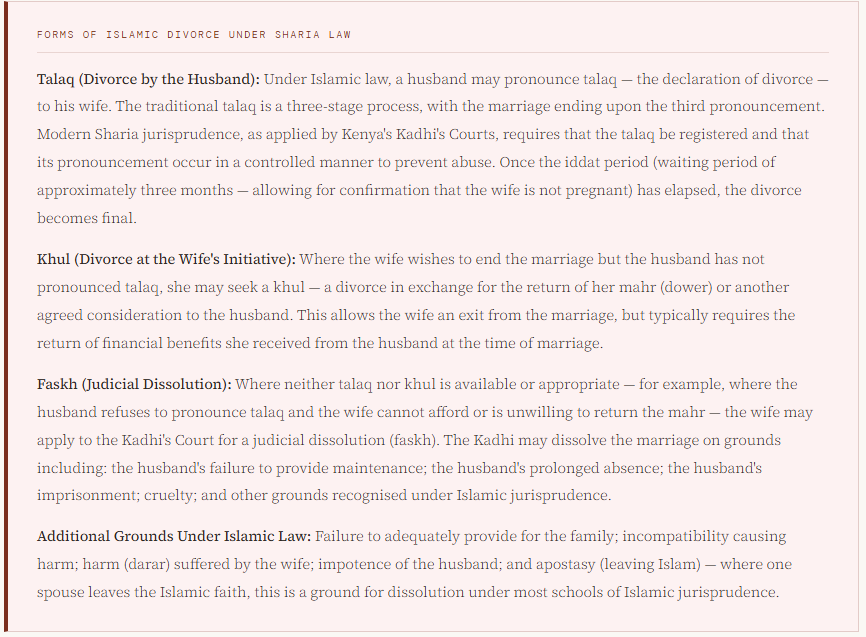
The dissolution of an Islamic marriage in Kenya is governed by Islamic law Sharia and is handled by the Kadhi’s Court, not the ordinary civil courts. The Kadhi’s Court is established under Article 170 of the Constitution of Kenya 2010 and the Kadhi’s Courts Act. It has jurisdiction over personal status matters including marriage, divorce, and inheritance for Muslims in Kenya.
It is important to note that while the Kadhi’s Court has jurisdiction over the dissolution itself, any matters arising from the dissolution that extend beyond personal status particularly property disputes involving non-Muslim parties, land, or significant commercial assets may need to be addressed in the ordinary civil courts alongside or following the Kadhi’s Court proceedings.
Hindu Marriage Dissolution — The Act and the Additional Ground
Hindu marriages in Kenya are governed by both the Marriage Act 2014 and the Hindu Marriage and Divorce Act (Cap 157, Laws of Kenya). A petition for dissolution of a Hindu marriage is filed at the High Court, following the general grounds applicable to all marriages under the Marriage Act 2014 adultery, cruelty, desertion, exceptional depravity, and irretrievable breakdown with one important additional ground specific to Hindu marriages.
Conversion to Another Religion: Where either spouse converts from Hinduism to another religion during the subsistence of the marriage, the other spouse may petition for dissolution of the marriage on this ground. This reflects the centrality of religious faith to the Hindu marital relationship as recognised under Kenyan law. The conversion must be genuine and not merely claimed for the purpose of obtaining a divorce.
The general procedural requirements the three-year minimum marriage period, the requirement for a Decree Nisi followed by a Decree Absolute, and the ancillary matters of custody, maintenance, and property apply to Hindu marriage dissolution in the same way as they apply to civil and Christian marriages.
The Decree Nisi — The Provisional Order of Dissolution
One of the most commonly misunderstood features of the Kenyan divorce process is the two-stage nature of the final orders: the Decree Nisi and the Decree Absolute. Many people believe that a court hearing at which the judge agrees that the marriage has broken down is the end of the legal process and are surprised to discover that they are not yet divorced. Understanding the distinction between these two orders is essential.
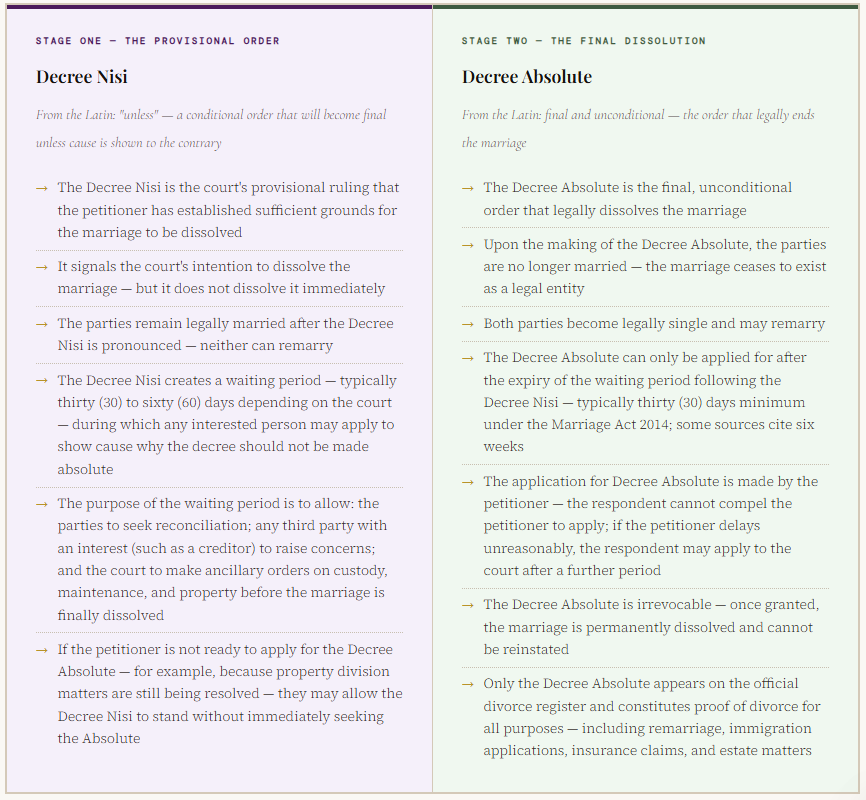
Marriage Act 2014 · Section 72 — The Two-Stage Dissolution
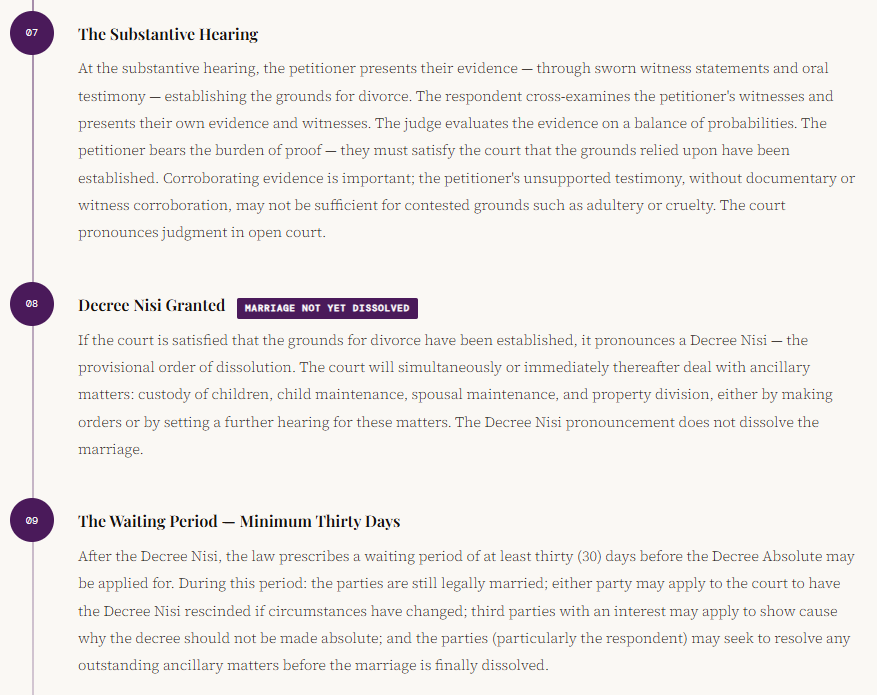
Section 72(1): A decree of dissolution of marriage shall, in the first instance, be a decree nisi. Section 72(2): A decree nisi shall not be made absolute before the expiration of the period specified in the decree, which shall be not less than thirty days after the date of the decree nisi, unless the court otherwise orders.
Marriage Act No. 4 of 2014 · Section 72
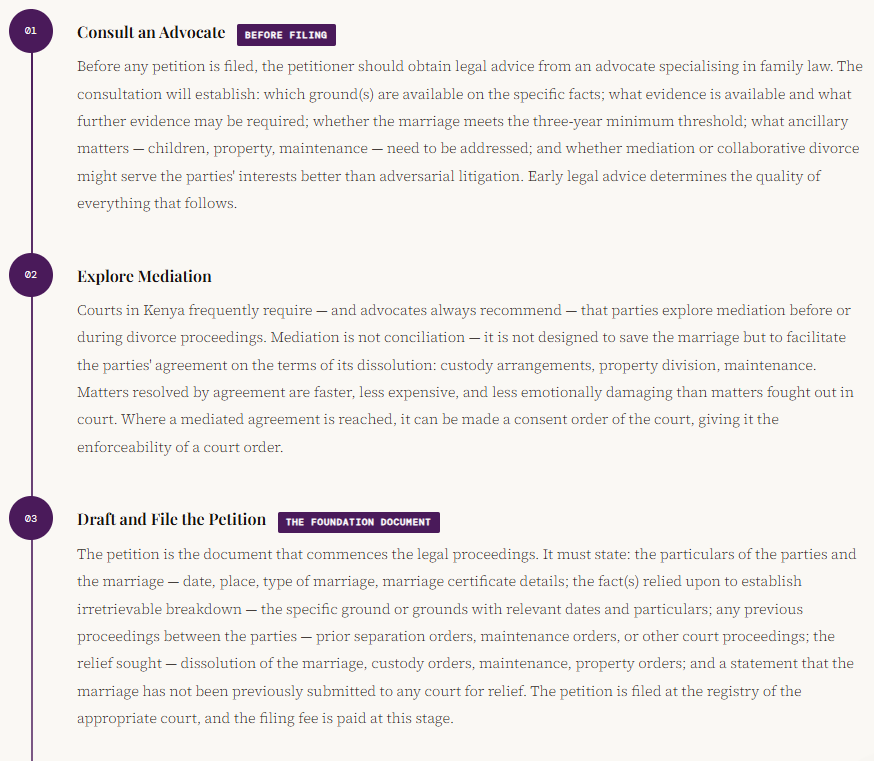
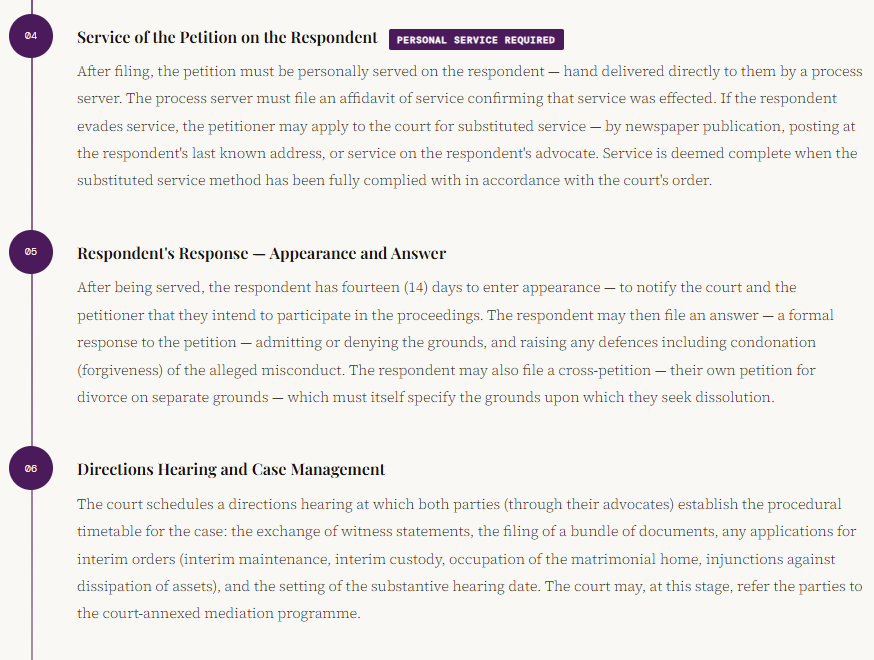
The Complete Step-by-Step Divorce Procedure — From Petition to Decree Absolute
A divorce is instituted through a petition filed in the Magistrates Court (for customary marriages and lower-value matters) or the High Court (for civil, Christian, and Hindu marriages with significant property interests). The following procedure applies to civil and Christian marriages the most common forms in which clients seek legal assistance.
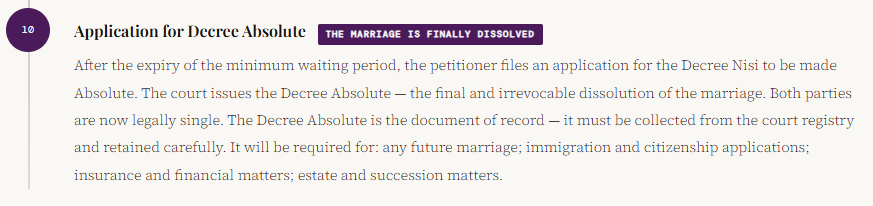
Contested versus Uncontested Divorce — The Significant Practical Difference
When a marriage faces irreparable challenges, the path to divorce can take two distinct forms and the choice between them has significant consequences for the time, cost, and emotional impact of the process.
Uncontested Divorce
An uncontested divorce also called a joint petition or consent divorce is one in which both parties agree that the marriage has broken down, agree on the ground to be used, and have reached agreement (or are willing to reach agreement) on all ancillary matters: custody, maintenance, and property. An uncontested divorce is significantly faster, less expensive, and less emotionally damaging than a contested one. Where both parties are in agreement, the matter can proceed by consent the court is presented with a joint petition and an agreed set of orders, and the judge simply gives effect to what the parties have agreed. In straightforward cases, this can be concluded in two to four months from filing.
Contested Divorce
A contested divorce is one in which the respondent denies the grounds for divorce, disputes the ancillary orders sought, or both. A contested divorce involves exchange of pleadings, disclosure of evidence, exchange of witness statements, and a full hearing at which both parties present evidence and are cross-examined. The cost is significantly higher legal fees for a contested divorce before the High Court can range from KSh 150,000 to several million shillings depending on complexity, the value of property in dispute, and the length of the proceedings. The duration is also significantly longer — a contested divorce may take one to three years or more from filing to conclusion. Where children are involved in a contested matter, this prolonged process causes real harm courts are increasingly robust in encouraging early resolution of custody matters, even where the divorce itself is contested.
“The most expensive divorce is the one that could have been an agreement. Not for lack of things to disagree about but for failure to recognize that what is fought over in court for two years will be resolved on terms little different from what was available to be agreed in two months. The toll that difference in time extracts financial, emotional, and on the children is the real cost of contested divorce.”
Ancillary Relief — Children, Property and Maintenance
Divorce does not begin and end with the dissolution of the marriage. The accompanying orders on the custody and maintenance of children, on the occupation and division of matrimonial property, and on spousal maintenance are frequently the most consequential and most contested aspects of divorce proceedings. These are the orders that determine how both parties will live after the marriage ends.
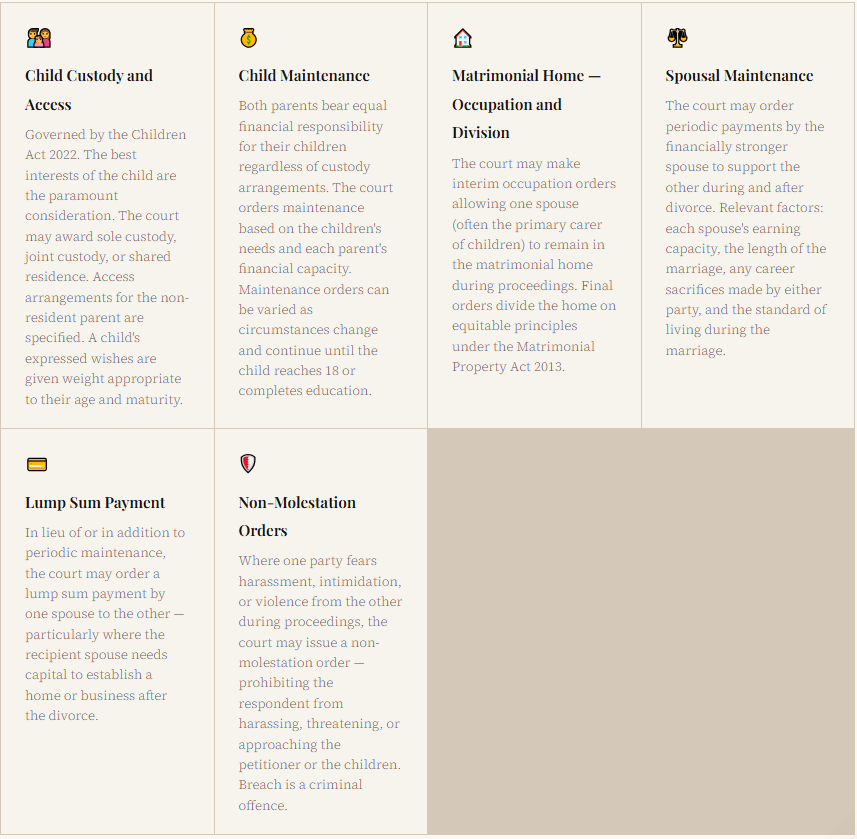
Division of Matrimonial Property — The Matrimonial Property Act 2013
The Matrimonial Property Act 2013, read with Article 45 of the Constitution, governs the division of property at divorce. The foundational principle is that both spouses’ contributions financial and non-financial are recognized in determining each party’s share. In the landmark case of Peter Mburu Echaria v Priscilla Njeri Echaria [2007] KECA 504 (KLR), the Court of Appeal established that non-monetary contributions such as domestic work, childcare, and emotional support are relevant when dividing matrimonial assets. This principle is now codified in the 2013 Act.
Property acquired before marriage remains the individual’s property unless the other spouse contributed to its improvement. Property acquired during the marriage whether in one name or both is matrimonial property subject to equitable division. The division must be fair and equitable, not necessarily equal the court considers the nature and extent of each spouse’s contribution, the length of the marriage, the needs of the parties and their children, and any agreement between the parties.

The law of divorce and separation in Kenya is comprehensive, structured, and when properly navigated designed to produce fair outcomes for all parties, including the children whose welfare the courts treat as paramount. But the legal process is complex, emotionally charged, and consequential in ways that extend well beyond the legal proceedings themselves. The decisions made in the early stages of a divorce about how to structure the petition, what evidence to gather, how to approach ancillary matters, and whether to pursue agreement or litigation shape outcomes that the parties will live with for years.
We advise clients across the full range of family law matters divorce petitions under the Marriage Act 2014; Deeds of Separation for couples who are not yet ready for divorce; custody and access arrangements; maintenance applications; matrimonial property disputes under the Matrimonial Property Act 2013; and the specific requirements of customary marriage dissolution, including the cultural dimensions of bride price negotiation and elder mediation. We appear in the High Court, the Magistrates Court, and in mediation proceedings.
We are also available urgently, where necessary for clients who are in abusive situations and need immediate protective orders: non-molestation orders, occupation orders for the matrimonial home, and interim custody orders to protect children. If you or your children are in danger, please contact us immediately these orders can be obtained on short notice and do not require the marriage to have been dissolved before they take effect.
Every client who comes to us in a family law matter receives advice that is legally precise, practically grounded, and delivered with the understanding that they are not navigating a legal problem they are navigating a human one. The law is our instrument. Their protection and their children’s welfare are our purpose.
O.M.O Law · Nairobi · Thika · Nakuru · Kenya · This article constitutes general legal information only and does not constitute legal advice on any specific matter. Legal obligations are fact-specific. Contact us for advice on your business’s specific situation.