What Fintechs, Banks, Investors and Their Business Partners Should Do Before 9th October.
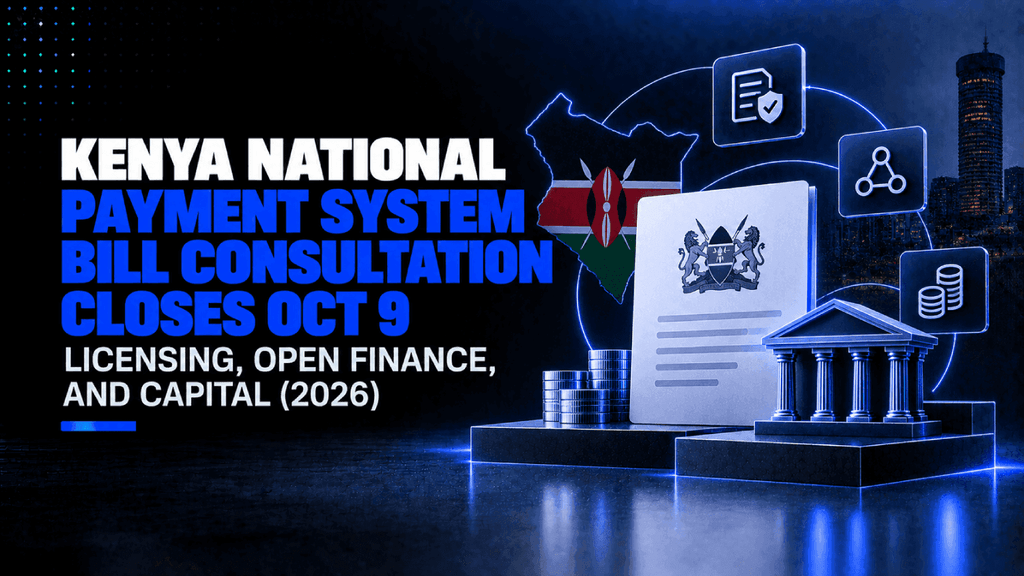
The National Payment System Act (Cap. 491A) of Kenya is the primary legislation that governs, regulates, and supervises payment systems, payment instruments, and payment service providers (PSPs).
The National Payment System Bill, 2026 to repeal and replace the existing National Payment System Act (Cap. 491A). Previously the NATIONAL PAYMENT SYSTEM ACT CAP. 491A was
- Published in Kenya Gazette Vol. CXIII—No. 122 on 16 December 2011
- Assented to on 2 December 2011
- Commenced on 24 March 2014
- [Amended by Microfinance (Amendment) Act, 2013 (Act No. 41 of 2013) on 11 December 2013]
- [Amended by Companies and Insolvency Legislation (Consequential Amendments) Act, 2015 (Act No. 19 of 2015) on 3 July 2017]
- [Revised by 24th Annual Supplement (Legal Notice 221 of 2023) on 31 December 2022]
- [Amended by Anti-Money Laundering and Combating of Terrorism Financing Laws (Amendment) Act, 2023 (Act No. 10 of 2023) on 15 September 2023]
It was An Act of Parliament to make provision for the regulation and supervision of payment systems and payment service providers, and for connected purposes.
The draft National Payment System Bill, 2026 is not yet law. But for businesses operating in payments, fintech, digital wallets, remittances, merchant acquiring, payment gateways, open finance or related technology, the proposed framework is important enough to start planning now, not after Parliament has finished with it.
On 21st September 2026, the Central Bank of Kenya and the National Treasury published the Draft National Payment System Policy and National Payment System Bill, 2026, proposing to repeal the existing National Payment System Act, Cap. 491A and replace it with a substantially broader statutory framework. The stated policy objectives include interoperability, innovation, financial inclusion, market integrity, consumer protection, data protection and financial stability. Public comments are due by 9 October 2026.
This is therefore not simply a technical regulatory update for compliance officers.
It can affect how a business is incorporated, how much capital it must maintain, who may own it, who may sit on its board, which functions may be outsourced, how customer funds are held, how data moves, how acquisitions are completed, how cross-border payments are documented and what happens when the regulator believes the business is in difficulty.
For investors and business owners, the practical question is not merely “What does the Bill say?”
It is:
If this framework becomes law substantially in its present form, what does it change about the way my business is structured, funded, governed and operated?
THE FIRST QUESTION IS WHETHER YOUR BUSINESS IS ACTUALLY INSIDE THE NEW PERIMETER
One of the most important features of the draft Bill is the breadth of the proposed regulatory perimeter.
The Bill covers persons providing payment services, operating payment systems, issuing electronic money, operating payment messaging systems, payment initiation and account-information services, card schemes, cross-border payment systems and certain ancillary services. It also expressly contemplates persons processing, storing or sharing data on behalf of payment providers and persons providing ancillary services supporting payment systems.
The proposed licensing structure is correspondingly more granular.
It identifies six payment-service-provider categories:
- Payment Initiation Service Provider;
- Account Information Service Provider;
- Merchant Acquirer;
- Electronic Wallet Provider;
- Money Remittance Service Provider; and
- Electronic Money Issuer.
It separately identifies four payment-system-operator categories:
- Payment Gateway;
- Payment Messaging System Operator;
- Card Scheme Operator; and
- Payment Switching and Clearing System Operator.
That distinction matters commercially.
A technology company may believe that it is simply providing software.
A group may believe that its Kenyan subsidiary is merely processing payments for its foreign parent.
A business may believe that its payment gateway is merely a technological layer.
The legal classification may tell a different story.
The first exercise should therefore be regulatory mapping—not incorporation.
Before establishing the company, acquiring another business or launching the product, identify precisely what the business does, where money moves, who controls the payment infrastructure, who holds customer funds, what data is processed and which functions are outsourced.
That analysis should drive the corporate structure.
Not the other way around.
THE COMPANY STRUCTURE MAY BECOME PART OF THE REGULATORY STRATEGY
The draft Bill provides that an applicant for a payment-service licence must be either a company limited by shares registered under the Companies Act or a foreign company limited by shares holding a certificate of compliance under the Companies Act. The Central Bank would assess, among other matters, the applicant’s financial condition, management, capital structure, source of funds, data-handling capacity, system resilience, consumer-protection mechanisms and compliance with other applicable laws.
That has a direct implication for transactional lawyers and investors.
Choosing a company type is not merely a registration exercise.
The intended business determines the legal architecture.
A founder planning a regulated fintech should be asking:
- Who owns the operating company?
- Is there a holding company?
- Where will intellectual property sit?
- Which entity employs the technical team?
- Which entity contracts with customers?
- Which entity holds the regulatory licence?
- Who provides financing?
- Which entity owns the technology?
- What happens if the operating company is sold?
- What happens if an investor acquires 15%?
- What happens if the business expands into another regulated activity?
- How will related-party transactions be documented?
The Companies Act structure, shareholders’ agreement, financing documents, IP arrangements, employment structures and regulatory licence should be designed as one transaction architecture.
They should not be six unrelated legal files.
CAPITAL IS NO LONGER JUST A FUNDRAISING QUESTION
The proposed Third Schedule establishes minimum capital requirements ranging from Kshs. 5 million to Kshs. 250 million, depending on the licence category.
Among the proposed thresholds:
| Proposed category | Minimum capital |
| Payment Initiation Service Provider | Kshs. 5 million |
| Account Information Service Provider | Kshs. 5 million |
| Money Remittance Service Provider | Kshs. 30 million |
| Merchant Acquirer | Kshs. 50 million |
| Electronic Wallet Provider | Kshs. 50 million |
| Electronic Money Issuer | Kshs. 250 million |
| Payment Gateway | Kshs. 10 million |
| Payment Messaging System Operator | Kshs. 20 million |
| Card Scheme Operator | Kshs. 50 million |
| Payment Switching & Clearing System Operator | Kshs. 50 million |
These are proposed requirements, not requirements currently in force under the draft Bill.
But an investor considering entry into the Kenyan payments market should not wait until the legislation is enacted before considering the consequences.
If a business requires Kshs. 250 million in regulatory capital, that fundamentally changes:
- the investment proposition;
- the shareholders’ agreement;
- the funding model;
- dilution negotiations;
- shareholder loans;
- reserve planning;
- acquisition valuations;
- financial projections; and
- exit strategy.
Regulatory capital is therefore a transaction issue as much as a regulatory issue.
“WE CAN OUTSOURCE IT” MAY NO LONGER BE A SIMPLE ANSWER
Modern businesses outsource almost everything:
- cloud infrastructure;
- software development;
- cybersecurity;
- customer support;
- data processing;
- KYC;
- fraud monitoring;
- accounting;
- payment processing;
- hosting;
- compliance technology.
The proposed Bill would require prior written CBK approval where a payment service provider or payment system operator intends to outsource an operational function. The outsourcing arrangement must not impair internal controls or the regulator’s ability to monitor compliance. An “operational function” is broadly tied to functions whose failure could affect licensing compliance, financial performance or continuity of payment services.
This means a major technology or supplier agreement may become a regulatory document.
A standard supplier agreement may not be enough.
A regulated business should be reviewing:
- audit rights;
- access to systems and records;
- business continuity;
- cybersecurity;
- subcontracting;
- data processing;
- incident notification;
- regulatory access;
- termination rights;
- transition assistance;
- disaster recovery;
- jurisdiction;
- confidentiality;
- data location;
- step-in rights; and
- post-termination data handling.
The contract has to work not only between the customer and supplier.
It has to work when the regulator enters the picture.
CUSTOMER MONEY IS BEING GIVEN A DIFFERENT LEGAL CHARACTER
The proposed Bill contains detailed provisions for trust arrangements.
Electronic-money issuers and electronic-wallet providers would be required to maintain customer funds in trust arrangements. The balance in the trust account must not fall below what is owed to customers. Trust funds cannot simply be moved into the provider’s ordinary operating account or used for unrelated purposes.
More significantly, the draft provides that money in the trust account would not be available for satisfying the provider’s debts or for settling its liabilities in insolvency.
The proposed framework also limits the amount that an electronic-money issuer or electronic-wallet provider may hold in one bank to Kshs. 500 million or 25% of the trust-account monies, whichever is higher.
That has consequences beyond regulatory compliance.
It affects:
Banking relationships.
Treasury arrangements.
Escrow and trust structures.
Security documentation.
Insolvency planning.
Customer protection.
Investment structuring.
Cash management.
A fintech’s banking agreements should therefore be reviewed alongside the proposed statutory framework.
OPEN FINANCE MEANS DATA BECOMES PART OF THE TRANSACTION ARCHITECTURE
The draft Bill proposes that payment service providers and payment system operators maintain systems capable of securely sharing customer data for open-finance purposes.
The Central Bank could require such sharing after obtaining customer consent, with detailed implementation left to regulations.
This is where payments law, technology contracts and data-protection law converge.
A business should be able to answer:
What data do we hold?
Why do we hold it?
Who can access it?
Who processes it for us?
Where is it stored?
When can it be shared?
What happens when the customer withdraws consent?
What happens when the relationship with the processor ends?
Can we demonstrate compliance to the regulator?
The ODPC already maintains a compliance regime involving registration, data protection impact assessments, inspections and audits.
For a regulated fintech, therefore, data protection cannot sit in a privacy-policy folder while the commercial team designs the product elsewhere.
Privacy, technology, contracts and regulatory compliance must be designed together.
AN INVESTMENT INTO A REGULATED BUSINESS MAY REQUIRE REGULATORY APPROVAL BEFORE COMPLETION
This is particularly important for investors, private-equity funds and corporate groups.
The draft Bill proposes that no merger or acquisition of a payment service provider or payment system operator may occur without prior written approval of the Central Bank, subject also to the Competition Act.
It would similarly require prior CBK approval for a significant change of ownership, with an incoming shareholder acquiring at least 10%, directly or indirectly, treated as a significant change of ownership for the proposed framework. New significant shareholders would undergo vetting.
That changes how acquisition transactions should be documented.
A buyer should not simply negotiate:
SPA → completion → transfer of shares.
The transaction architecture may instead require:
Due diligence → regulatory analysis → competition analysis → regulatory approval → conditions precedent → financing → completion → post-completion compliance.
That distinction can determine whether a transaction completes on time.
It can also determine whether the buyer has the right to walk away.
DIRECTORS AND SHAREHOLDERS ARE NO LONGER MERELY CORPORATE ACTORS
The draft Bill proposes fit-and-proper assessments for significant shareholders, directors, senior officers and trustees.
The proposed criteria include professional competence, probity, diligence, judgment, reputation, integrity, honesty, criminal history, improper business practices and bankruptcy.
That means the shareholder agreement of a regulated business should be drafted with the regulatory regime in mind.
For example:
What happens if a shareholder ceases to be fit and proper?
What happens if a director becomes disqualified?
Can the company compulsorily transfer the shares?
What happens to voting rights?
Can an investor nominate a replacement director?
What happens if the regulator objects to the proposed nominee?
These are not theoretical drafting questions.
They can become transaction-completion questions.
THE REGULATOR’S INTERVENTION POWERS MAKE GOVERNANCE A BOARD-LEVEL ISSUE
The draft Bill proposes extensive supervisory and intervention powers.
The CBK could issue directives where conduct creates or is likely to create instability or systemic risk, or where the entity has contravened or is likely to contravene the proposed law.
The draft also provides for inspections, including entry to premises with or without notice, examination and retention of records, and consolidated supervision where the payment provider forms part of a group.
The proposed administrative enforcement regime could include restrictions on new business, suspension or revocation of licences and requiring a director or senior officer to be removed and replaced by a person acceptable to the CBK.
For a board, that changes the question from:
“Are we technically compliant?”
to:
“Can we demonstrate, continuously and quickly, that we are compliant?”
That requires governance systems.
THE PRACTICAL LESSON FOR KENYAN BUSINESSES IS BROADER THAN FINTECH
The proposed framework is a useful reminder of a principle that applies across regulated business:
Legal risk rarely sits in one department.
A business may have:
Employment contracts — but its senior officers may also be subject to regulatory fit-and-proper requirements.
Supplier agreements — but critical outsourcing may require regulatory approval.
Banking relationships — but customer funds may need special protection.
Shareholders — but a new investor may require regulatory approval.
Data/privacy obligations — but open-finance requirements may determine how data is shared.
Debt and financing — but regulatory capital cannot necessarily be treated as ordinary working capital.
Tenders and procurement — but regulated operations may impose additional contractual controls.
Leases and land — but a regulator may need access to premises or records.
Corporate governance — but regulatory intervention can reach directors and senior officers.
M&A — but completion may be conditional upon sector approval.
That is why sophisticated businesses increasingly need something different from an advocate who is called only when a dispute arises.
They need one legal team that understands the business as a system.
What should a business do now?
The draft Bill is still under public participation. It is not yet law, and its provisions may change before enactment. CBK and National Treasury have expressly published the Bill and policy for public participation.
For a business operating anywhere near the payments ecosystem, however, there is value in conducting a pre-enactment readiness review now.
We would suggest asking:
1. Regulatory perimeter
Does our business fall within one or more proposed categories?
2. Corporate structure
Is our present company structure suitable for the business we actually conduct?
3. Capital
Would the proposed capital requirement change our funding model?
4. Ownership
Could future investment or restructuring trigger regulatory approval?
5. Governance
Are the board, shareholders and senior management arrangements capable of meeting fit-and-proper requirements?
6. Contracts
Which supplier, technology, outsourcing, banking and customer contracts would need revision?
7. Data
Can our data architecture support lawful sharing, retention, security and regulatory access?
8. Customer funds
Are customer monies sufficiently separated from operating funds?
9. M&A
Would an acquisition require CBK and Competition Authority analysis before completion?
10. Business continuity
What happens if the licence is suspended, operations are restricted or a critical supplier fails?
The commercial outcome
The best time to discover that a business model is incompatible with its regulatory structure is before the capital is committed.
The best time to discover that an acquisition requires regulatory approval is before signing an unconditional completion obligation.
The best time to discover that a supplier agreement does not give the regulator sufficient access is before the supplier becomes mission-critical.
And the best time to discover that your corporate structure cannot accommodate the next investor is before the investor’s money is on the table.
Kenya’s proposed National Payment System Bill is therefore not simply a compliance story.
It is a corporate structuring, investment, financing, contracting, governance, data and transaction story.
That is precisely where transactional lawyering earns its value.
The objective is not to react to regulation after it changes the business. It is to understand the regulatory direction early enough to make better business decisions now.
O.M.O Law · Nairobi · Thika · Nakuru · Kenya ·
This article constitutes general legal information only and does not constitute legal advice on any specific matter. Legal obligations are fact-specific. Contact us for advice on your business’s specific situation.